29,000, Give or Take
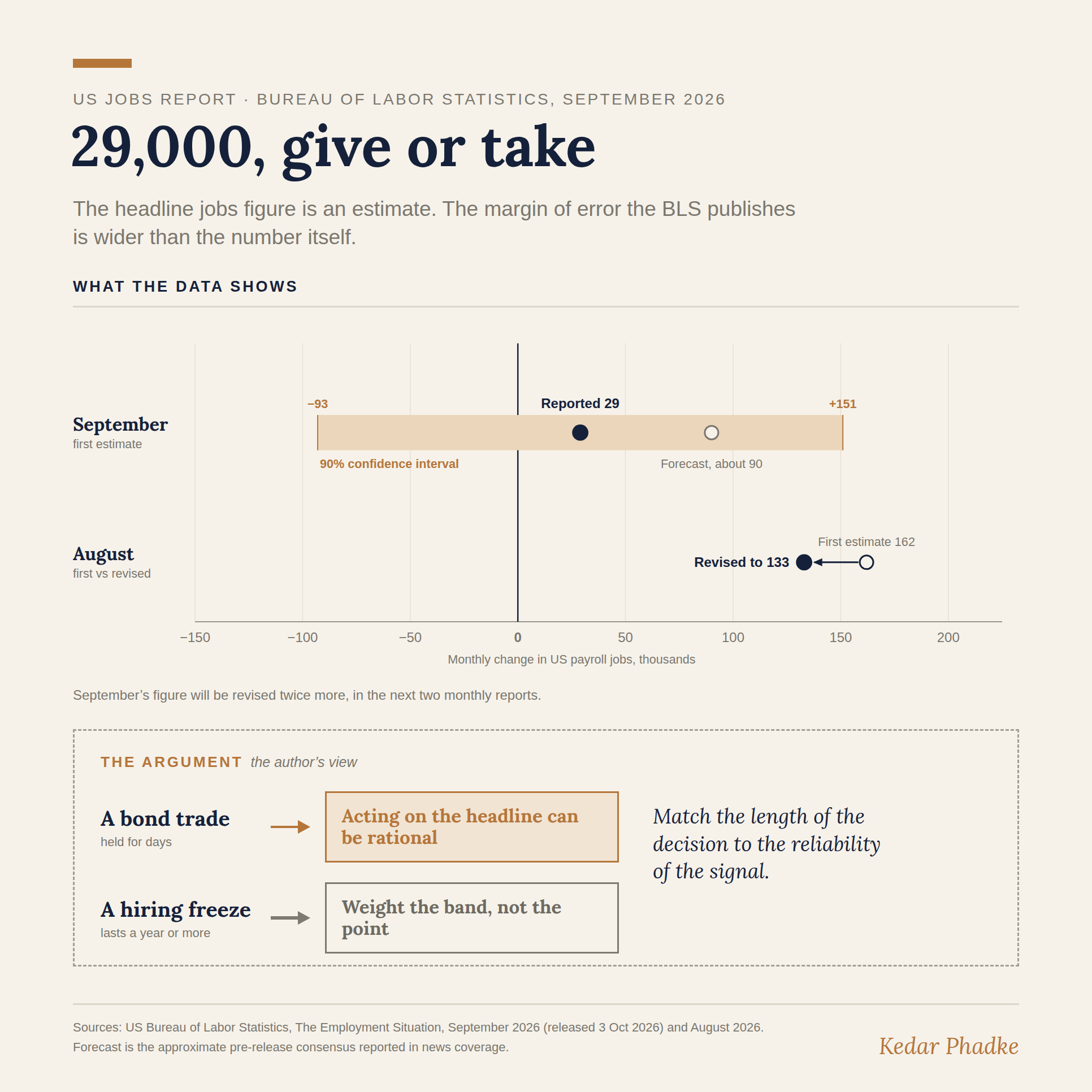
On Friday 3 October, the US Bureau of Labor Statistics said the economy added 29,000 jobs in September. Forecasters had expected about 90,000. News outlets called it a big miss, and many read the number as a verdict on the labour market.
The same report included a less-noticed detail. August was first reported as a gain of 162,000 jobs. That figure has now been revised down to 133,000. The August number shrank by 29,000 in just four weeks.
Every Published Number Is an Estimate
This revision points to an idea that analysts learn early but many readers forget. Any published number is an estimate, and every estimate has a margin of error.
The BLS is open about this. Its report says the 90% confidence interval for the monthly change in total nonfarm payrolls is about plus or minus 122,000. A figure of 29,000 is therefore statistically consistent with anything from a fall of about 93,000 to a gain of about 151,000. The gap between the forecast and the result fits comfortably within that range.
There is another detail that is easy to overlook. The confidence interval covers only sampling error, which comes from surveying some employers rather than all of them. Revisions like the one to August come from late survey responses and updated seasonal adjustments, which add further uncertainty. The true margin of error on a first estimate is wider than the published one.
The Market Is Not the Problem
This does not mean the market reaction was wrong. Bond traders are not betting on the actual number of jobs. They are betting on how the Federal Reserve and other traders will react to the number that is reported. Acting fast on a noisy figure can make sense when trades are closed within days.
Long Decisions, Short Signals
The mistake happens elsewhere. It happens when organisations make long-term decisions on short-term data. If a company stops hiring for a year because of one weak monthly report, that decision will outlast the estimate it was based on. By early December, September’s figure will have been revised twice. The hiring freeze will not be reversed so quickly.
People in finance know this as a matching problem. Match how long your decision lasts to how reliable the data is. If your time frame is short, it makes sense to react to the headline. If your commitment is longer, pay more attention to the margin of error and to slower-moving information.
What This Means
For those of us who teach statistics, this is a gift. The world’s most-watched economic number comes with its own margin of error, and that detail is rarely mentioned. Asking students to find it, and to explain what it does and does not cover, teaches more than a week of textbook exercises.
Match the length of the decision to the reliability of the signal.
When a single data release changes a plan in your organisation, how long is the decision it changes expected to last?
The payroll figures are estimates from the BLS establishment survey and will be revised again. The confidence interval reflects sampling error only. The forecast figure comes from news coverage, not from the BLS, and pre-release forecasts ranged from about 84,000 to 90,000. The argument about matching decisions to signals is my interpretation.
Sources
- US Bureau of Labor Statistics, “The Employment Situation, September 2026”, released 3 October 2026. Total nonfarm payroll employment rose by 29,000 (preliminary), and August was revised to 133,000. The release states that the 90 per cent confidence interval for the monthly change in total nonfarm employment is on the order of plus or minus 122,000. Monthly revisions reflect additional reports from businesses and government agencies and the recalculation of seasonal factors.
- US Bureau of Labor Statistics, “The Employment Situation, August 2026”, released 4 September 2026, which first reported August at 162,000.
A version of this essay was first shared on LinkedIn.