Who Holds the First Loss?
Several large banks have been looking for ways to pass on part of the risk on loans they made to build AI data centres, according to Bloomberg reporting since August 2026. It is easy to read this as a sign of nerves. I think it is better read as a question about incentives.
A Fast-Growing Pile of Debt
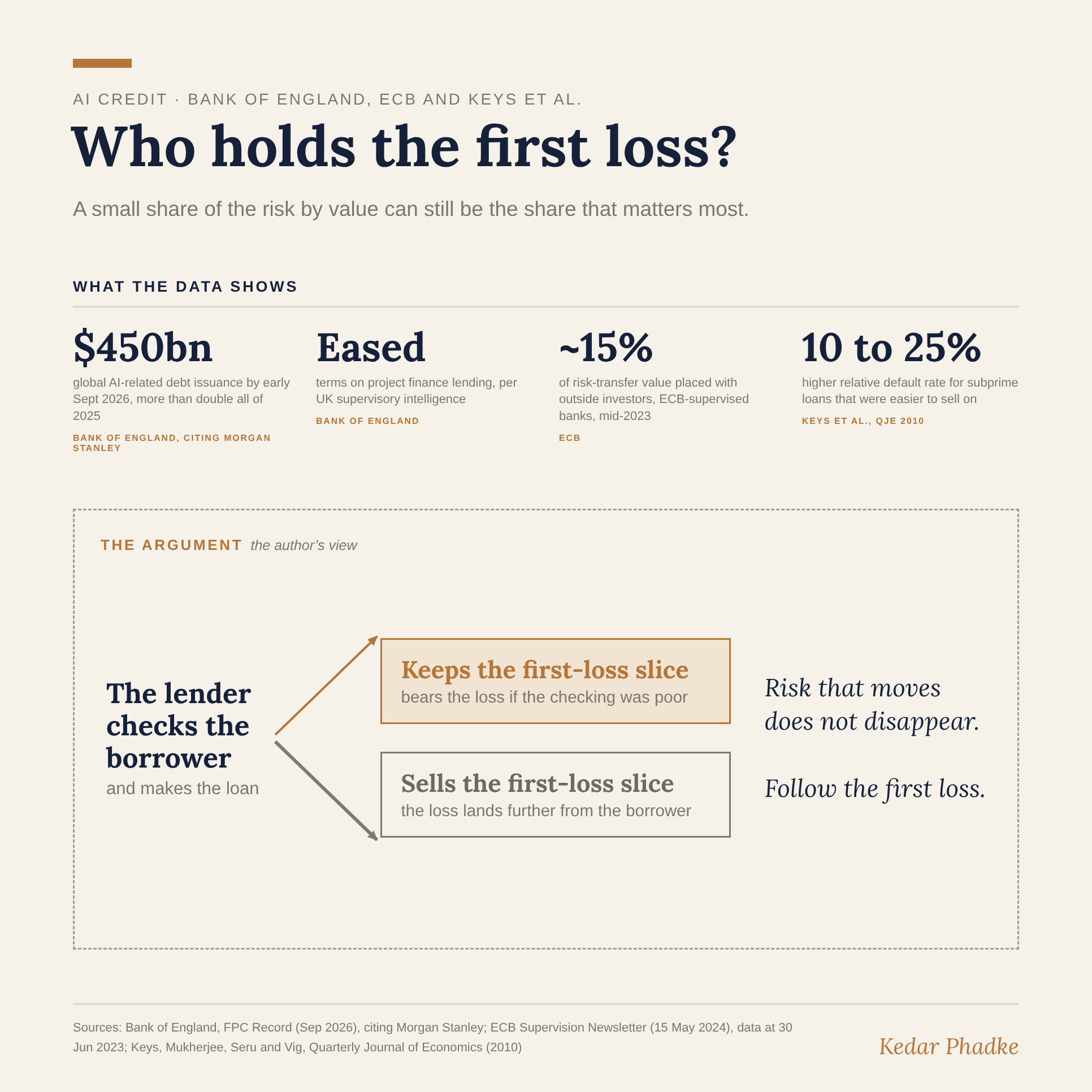
In its September 2026 record, the Bank of England’s Financial Policy Committee cited a Morgan Stanley estimate that global AI-related debt issuance reached around $450 billion by early September. That is more than double the total for all of 2025.
The same record notes that lending terms on project finance in general have eased significantly. Investor demand for this kind of debt has also been strong, including from private market investors.
An Old Idea From Finance
Put those two facts side by side and an old idea comes into view. Finance researchers call it the originate-to-distribute problem. A bank that expects to keep a loan has every reason to check the borrower carefully, because it will bear the loss if it gets this wrong. A bank that expects to pass the risk on has less reason to look, because someone else will bear the loss.
This is not just theory. In a 2010 study, economists Benjamin Keys, Tanmoy Mukherjee, Amit Seru and Vikrant Vig looked at US subprime mortgages. A rule of thumb in the market made some loans easier to sell on to investors. Among the loans that were sold on, the easier-to-sell group defaulted at a rate around 10 to 25 per cent higher than a group with a similar risk profile. The borrowers looked alike on paper. The checking was weaker in practice.
Why Today Is Different, and Why It Still Matters
Today’s deals are not the mortgage pipelines of 2008. In a synthetic risk transfer, the bank keeps the loans on its books and passes on part of the credit risk through guarantees or credit derivatives. European Central Bank data from mid-2023 showed that only about 15 per cent of the value of these deals was placed with outside investors. Selling down risk to stay within exposure limits and free up capital is sensible banking. I am not suggesting anyone is dumping bad loans.
But a small share by value is not the same as a small share of the risk. Bloomberg reported in September 2026 that investors in these deals earn double-digit returns for taking on a portion of the default risk. That price tells you something. Nobody is paid double-digit returns to hold the safest part of a loan. The risk that leaves is the risk whose value depends most on how carefully the borrower was checked. When a bank knows, at the moment it lends, that it can sell that risk to eager buyers, its reason to scrutinise the next project weakens a little.
Easier lending terms are what you would expect if that were happening. They are also what you would expect in an ordinary competitive boom. From the outside, I cannot tell the two apart. I suspect many of the people buying the risk cannot either.
Follow the First Loss
So my position is this. The most useful number in the AI financing debate is not the total amount of debt. It is the share of the first-loss slice still held by whoever checked the borrower. Risk that moves does not disappear. It moves to investors who sit further from the borrower and often know less about it.
If you allocate money to AI credit, whether as a pension trustee or for a family office, ask one question before you look at the yield. Who held the first loss when the loan was made, and do they still hold it?
For students, the habit works far beyond AI. In any deal, follow the first loss. That is where the incentive to look carefully lives.
Risk that moves does not disappear.
Where else in the AI economy do you see the people best placed to judge a risk ending up holding less of it?
The reporting on bank risk transfers comes from Bloomberg. The point that the risk being sold is the riskier part rests on the double-digit returns investors are reported to earn, not on disclosed deal structures, which are private. The ECB retention figure covers euro-area banks it directly supervises, as of mid-2023, and is not specific to data-centre lending. The Keys et al. result is a relative difference in default rates among US subprime loans. The argument about first-loss retention is my interpretation.
Sources
- Bloomberg, “Asia Data Center Debt Binge Hitting Banks’ Limits, Barclays Says,” 31 August 2026, on banks reaching sector limits on data-centre lending and using significant risk transfers to pass on part of the risk.
- Bloomberg, “Deutsche Bank Hedges Data Center Risk in SRT on €2 Billion Book,” 7 September 2026, reporting that several European and North American banks have considered or completed such deals, and that they offer investors double-digit returns for taking on a portion of the default risk.
- Bank of England, “Financial Policy Committee Record, September 2026”, meeting of 25 September, published 30 September 2026. Paragraph 11 cites Morgan Stanley’s estimate of around $450 billion of global AI-related debt issuance as of early September, more than double the total for 2025. Paragraph 23 reports that terms and conditions on project finance lending had eased significantly.
- European Central Bank, “EU securitisations: 2023 in figures”, Supervision Newsletter, 15 May 2024. Data as of 30 June 2023. At origination, banks retain the major portion of significant risk transfer instruments, with about 15 per cent of notional volume placed with third-party investors.
- Benjamin Keys, Tanmoy Mukherjee, Amit Seru and Vikrant Vig, “Did Securitization Lead to Lax Screening? Evidence from Subprime Loans”, Quarterly Journal of Economics 125, no. 1 (2010): 307 to 362.
A version of this essay was first shared on LinkedIn.