The Degree Still Opens the Door. It No Longer Sorts the Room.
Many people saw computer science as a safe choice in an economy shaped by AI, as the degree is closely tied to the technology. However, new research from economists at the Federal Reserve Bank of Dallas questions that idea.
Samuel Dodini and Tucker Smith examined records from Texas public university graduates. After ChatGPT was released in late 2022, graduates from disciplines more exposed to AI automation, such as computer science and computer engineering, were less likely to find a job in Texas within a year. For every 10 points of additional exposure to AI, the chance of finding work in Texas fell by 1.7 percentage points compared to fields such as nursing and education. Those who did find work saw first-year earnings fall about 5 per cent relative to less-exposed disciplines.
Yet LinkedIn’s August research shows a different picture at the top of the same market. Generation Z accounts for over two-thirds of new hires for AI engineer roles, which typically advertise salaries around $161,000. Only 7 per cent of last year’s AI engineer hires did not have a bachelor’s degree. So the degree still matters. What it no longer does is more specific.
The Door and the Room
Michael Spence’s 1973 theory of labour market signalling offers one way to read this. Employers cannot directly observe how productive someone will be, so they look for signals, and a degree is the most common one. The signal plays two roles. It decides who gets considered, and it suggests how capable a candidate might be.
Read together, the two datasets suggest a computer science degree still gets graduates through the door, and in AI roles, employers may rely even more on degrees. But it says less about which room they end up in. Some obtain six-figure jobs, while the average graduate does not fare as well, and whatever separates them does not appear to show up on the transcript.
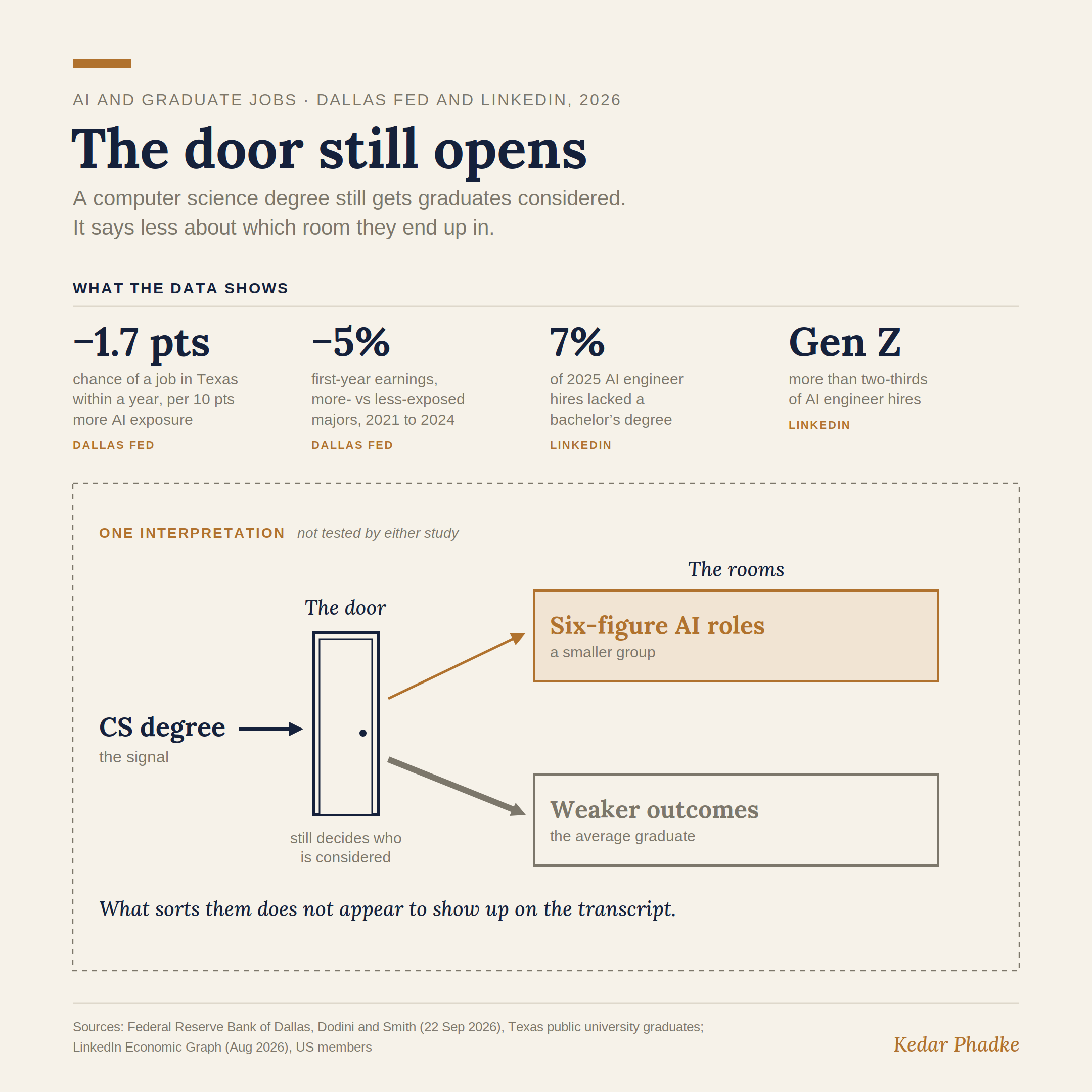
That is my own interpretation, not something either study directly tested. The Dallas Fed authors take a simpler view: generative AI has reduced demand for skills it can automate. Both explanations may be partly true.
In conversations across management education, I hear a related story. MBA graduates in marketing, finance and analytics often find campus offers tilted towards engineering roles. Recruiters increasingly ask for AI skills, yet how much those skills are used on the job is often unclear. Some employers may simply be preparing for what is coming. If so, “AI skills” is already working as a screen before anyone has shown what it predicts.
The Costlier Signal That Did Not Pay Off
In 2024, graduates from disciplines more exposed to AI were 1.4 percentage points more likely to go to postgraduate study for every 10 points of exposure. Two-thirds of computer science graduates who returned to study chose to remain in computer science.
In Spence’s terms, a more demanding qualification is how strong candidates try to stand out. However, early evidence suggests this approach is not effective. Recent master’s graduates in AI-exposed fields experienced similar relative declines in earnings as those with bachelor’s degrees. So further study in the same field does not seem to restore the pay advantage.
The Structural Incentive We Should Examine Honestly
As educators, we have a vested interest in providing more of the same qualification. Postgraduate courses in technical fields where demand is high are financially attractive. This incentive is not inherently wrong, but it will not address the problem unless these courses show employers something an undergraduate degree does not. Students are already adapting. In Texas, undergraduate enrolment is starting to move away from subjects more exposed to AI.
The more useful response is assessment that shows AI-complementary capability, whatever the degree title. In practice, that means evidence of the ability to direct, check and improve AI on problems that need judgement.
A degree still decides who gets considered. It says far less about where a graduate belongs.
If a degree still gets a graduate through the door but no longer indicates to employers which role suits them best, what would a strong, employer-trusted signal of that difference look like? And who should design it?
The employment and earnings figures come from administrative records, not surveys, and cover graduates of Texas public universities only. The LinkedIn figures come from US platform data and are descriptive. The door-and-room reading is my interpretation; neither study tests it.
Sources
- Samuel Dodini and Tucker Smith, “AI plays a role in weak labor market for college graduates”, Federal Reserve Bank of Dallas, 22 September 2026. The 1.7 and 1.4 percentage-point figures are per 10 percentage points of higher exposure to AI automation; employment means employment in Texas within four quarters of graduation. The same article reports the master’s earnings result and a 4.8 per cent fall in undergraduate enrolment per 10 points of exposure between fall 2024 and fall 2025. Its exposure measure builds on a task-based metric developed by Anthropic.
- Matthew Baird, Silvia Lara and Mar Carpanelli, “The AI Talent Divide”, LinkedIn Economic Graph Research Institute, August 2026, and the accompanying Economic Graph article “The AI Opportunity Gap Isn’t Inevitable. We Can Still Close It”, 31 August 2026. The $161,000 figure is the typical advertised salary in postings that disclose pay, not realised earnings.
- Michael Spence, “Job Market Signaling,” Quarterly Journal of Economics 87, no. 3 (1973): 355 to 374.
A version of this essay was first shared on LinkedIn.