The Electrician Who Was Already Booked
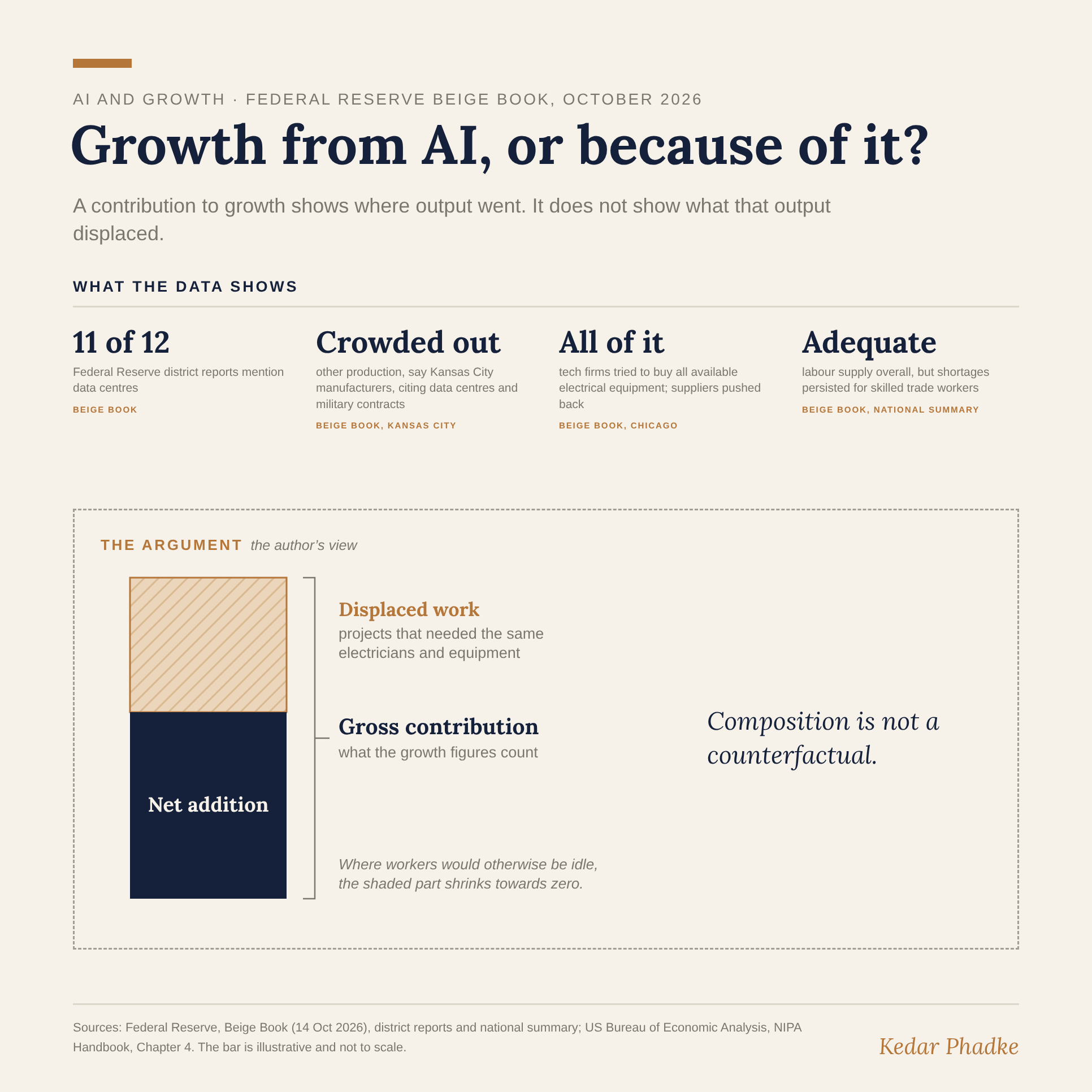
The Federal Reserve published its October Beige Book on 14 October 2026. It summarises what business and community contacts in each of the twelve Federal Reserve districts are telling their regional Reserve Bank. Eleven of the twelve district reports mention data centres.
Manufacturers in the Kansas City district said the data centre buildout, alongside military contracts, was crowding out other production. In the Chicago district, an equipment distributor said tech companies had tried to buy all the available electrical equipment for their data centre projects. Suppliers pushed back because of commitments to other projects. Dallas contacts reported data centre construction drawing workers away from other industries. In the San Francisco district, a large contractor in the Mountain West said competition from data centre projects had pushed up pay for electricians and other skilled trades.
Propping Up Growth, Compared With What?
Headlines in October 2026 described AI investment as propping up growth. The Beige Book quietly raises a different question. Propping up growth compared with what?
The lens here is opportunity cost, one of the first ideas any economics student meets. The true cost of anything is the next best thing the same resources could have produced. An electrician wiring a data centre is not wiring a factory line or a hospital wing.
Composition Is Not a Counterfactual
A common way to say that AI is holding up growth is to quote its contribution to growth. That calculation splits the change in GDP into the parts that came through each type of spending. The US Bureau of Economic Analysis describes contributions as a measure of the composition of growth. Composition, not counterfactual. The arithmetic tells you how much of the year’s change flowed through data centres. It does not tell you what the economy would have built without them.
That distinction matters only where inputs are scarce. Where workers and equipment would otherwise sit idle, the gross contribution and the net contribution are close. Where they are already fully booked, part of what is counted as AI-driven growth would have happened anyway, under a different label.
The Beige Book itself is careful on this point, and so should we be. It says labour supply was generally adequate to meet demand overall, while shortages persisted for specialised, technical and skilled trade workers. Its contacts are also not selected at random. So this is not evidence of crowding out across the whole economy. It is evidence of crowding out at specific bottlenecks, reported by people well placed to see them.
Where the Gap Lives
I think the net contribution of AI investment to growth in 2026 is smaller than the headline contribution. The gap sits in a few narrow inputs, chiefly electrical equipment and skilled trades.
A reasonable economist could disagree. Supply of both will respond to higher prices, and over a long enough period the displacement shrinks. But the Beige Book describes these trade shortages as persisting. And look again at the Chicago story. The suppliers pushed back because the equipment was already promised to other projects. Whoever gets it, someone else does not. The short run is where the gap lives, and the short run is what a single year’s growth figures measure.
What This Means
For a leader, two things follow. If you are planning a capital project that needs the same electricians and equipment, your costs and your timeline are now partly set by someone else’s data centre. Budget accordingly. And when a board paper says AI investment is supporting growth, ask what it displaced.
For a student, the habit is the lesson. Every growth number is a comparison, and the most useful thing to ask of it is what the alternative would have been.
Every growth number is a comparison. Ask what the alternative would have been.
Has a project you are involved in been delayed or repriced because the people or equipment it needed were already committed to data centre work?
The Beige Book reports what contacts tell the Reserve Banks. It is anecdotal, its contacts are not selected at random, and it does not measure the size of any crowding out. The Kansas City report names military contracts alongside data centres. Headlines describing AI investment as propping up growth were observed in news coverage; this essay makes no claim about the underlying forecasts. The gross-versus-net argument is my interpretation.
Sources
- Federal Reserve, “Beige Book, October 2026”, released 14 October 2026 (information collected on or before 5 October 2026). District reports for Kansas City, Chicago, Dallas and San Francisco; eleven of twelve district reports mention data centres. The national summary states that labour supply was generally adequate to meet demand, while shortages persisted for specialised, technical and skilled trade workers.
- US Bureau of Economic Analysis, “NIPA Handbook, Chapter 4” (updated December 2023). Contributions to percent change provide a measure of the composition of growth in the aggregate.
A version of this essay was first shared on LinkedIn.